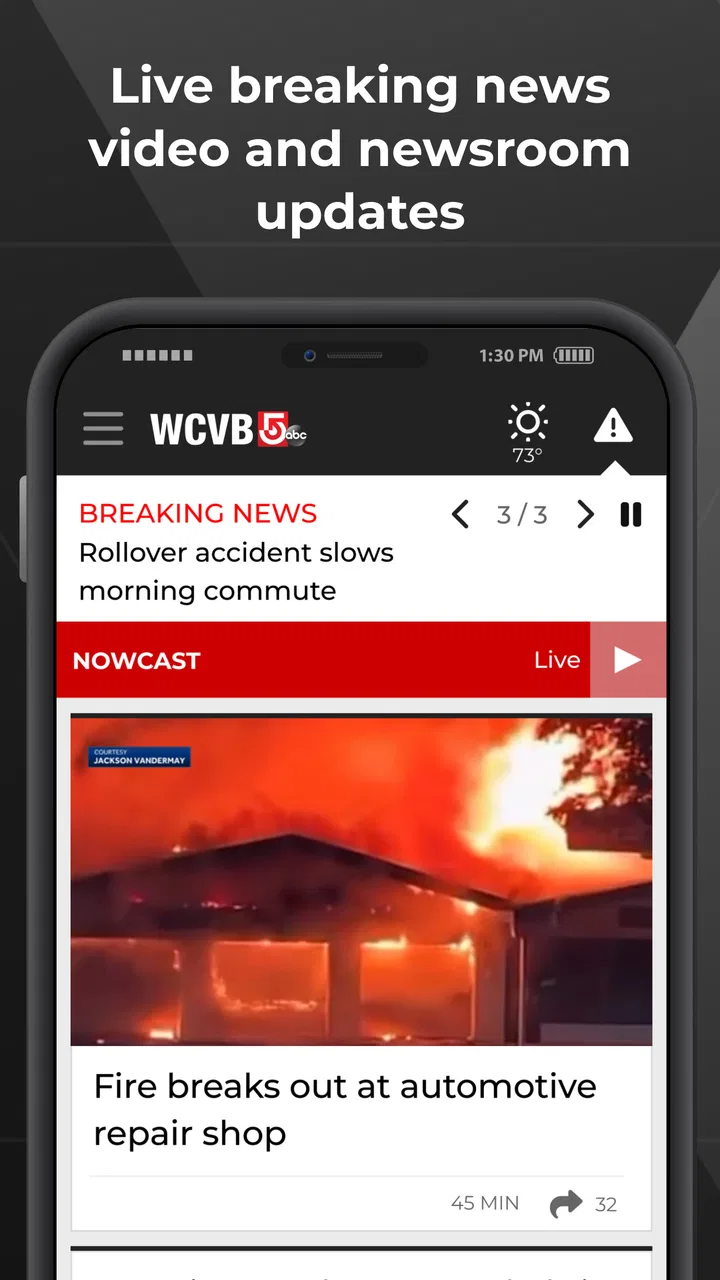
WCVB Newscenter 5 - Boston
- 4.7
- Rating
- 100.00K
- Installs
- Free
- Price

 Analysis by App-foxy
I installed WCVB Newscenter 5 to see whether it works as a practical Boston news companion rather than just another headline reader. My overall impression is that it is most useful when I want local information quickly: a developing story, a live newscast, a weather change, or coverage that national apps are unlikely to explain with the same regional focus. It is a free News & Magazines app from HTVMA Solutions, Inc., and its Everyone age rating makes it suitable for a broad household audience.
The important distinction is focus. This is not trying to be a general-purpose newsstand filled with international publications. Its value comes from putting Boston-area reporting, weather updates, live coverage, and breaking developments in one place. If your daily routine depends on local context, that narrow purpose can make it more useful than a larger app with far more content but less relevance to where you live.
How WCVB Newscenter 5 feels in everyday use
I look at everyday use through the questions that matter before installing a local news app: what information I’m choosing to receive, what choices I can actually make, and when I might prefer another source. For a Boston-focused reader, the useful next step is to decide which parts of the routine belong in the app and which are better handled elsewhere.
You May Also Like

 Blood Strike: 2.5 Anniversary
Blood Strike’s Loadouts Turn Every Drop Into a Tactical Gamble
A close look at Blood Strike’s custom loadouts: how fast access to signature weapons reshapes its battle royale rhythm, rewards preparation, and narrows the gap between fights.

 Pandora - Music & Podcasts
Pandora’s Music Is Easy to Start, but Harder to Recover
Pandora’s strength is its low-effort path from a seed to a station. Its weak spot is how much confidence it asks you to place in connection, setup, and quiet recovery.

 8 Ball Pool
 Is Built on Rivalries, Rematches, and Routine
A close look at the rivalries, rematches, shared routines, and unanswered safety questions that turn a quick pool match into a persistent mobile community.

 Samsung Music
’s Quiet Strength Is Playing What You Already Own
Its reach comes less from spectacle than from dependable access to a personal library. That simplicity is both the app’s strongest retention engine and its ceiling.

 AccuWeather: Weather Radar
AccuWeather Review: A Quick, Clear Forecast for Everyday Decisions
For everyday plans, the best forecast is the one you can understand quickly. AccuWeather makes rain timing, radar, and local conditions easy to act on, with a few trade-offs.

 Hill Climb Racing
Why Hill Climb Racing Still Turns Crashes Into One More Run
A tiny car, a bumpy hill and one more upgrade: Hill Climb Racing keeps resurfacing because its simple chaos makes every near-miss feel personal.
More From Our News Desk



Quick access matters more than endless browsing
My first test was simple: open the app with a specific question in mind instead of casually scrolling. That is the situation in which a local news app earns its place. I might be leaving for work and want to know whether a weather change could affect the trip, or I might hear about a developing Boston story and want a local source rather than a national summary. The app’s purpose is well suited to those short visits.
The perceived speed is strongest when I treat it as a check-in tool. I do not need to spend a long time navigating through unrelated subjects before reaching local coverage. The concentrated editorial scope helps reduce the mental work involved in finding something relevant. That does not mean every screen or update will feel equally immediate, since performance depends on the phone, connection, and the amount of current coverage being loaded, but the app’s local focus gives it a naturally direct feel.
For me, the best workflow is to open it with one of three intentions: check the latest local headlines, look for weather information, or watch coverage when a live newscast is available. Using those intentions keeps the experience efficient. If I open it expecting a broad replacement for every news source I use, the narrower scope becomes more noticeable.
A useful second screen during a busy morning
One realistic scenario is a weekday morning when I am getting ready and need information without committing to a full television segment. I can glance at local headlines, check the weather situation, and then return to whatever I was doing. Later, if a major local story develops, the live-news focus gives me a reason to come back instead of relying only on a general news feed.
This is where the app feels more practical than a newspaper-style reader for some people. A newspaper app may be better for long articles and deliberate reading, while a national aggregator may offer more variety. WCVB Newscenter 5 makes more sense when the question is, “What is happening around Boston right now?” rather than, “What is happening everywhere?”
I also appreciate the difference between reading a local report and searching the web manually. A web search can produce a mixture of old articles, unrelated results, and sources with different levels of local detail. A dedicated local app gives me a more consistent starting point. It does not remove the need for judgment, but it reduces the number of steps between opening the phone and reaching Boston-focused coverage.
Where heavier use changes the experience
The app’s workload naturally increases when I use several parts of it in one session. Reading headlines is a lighter task than moving between written coverage, weather information, and live video. A live newscast is especially different from ordinary browsing because it depends more heavily on a steady connection and asks the device to handle moving media rather than mostly text and images.
In those heavier moments, I judge the experience less by whether every transition is instant and more by whether the app remains understandable when conditions are imperfect. A brief pause while content loads is tolerable if I can tell what I selected and return to the main coverage without losing my place. A more frustrating session would be one in which a video or live section appears unavailable without a clear explanation, or where switching between sections feels unnecessarily awkward.
My practical advice is to use the app in layers. Start with the headline view when you only need orientation. Open a full story when the subject affects your plans or deserves more context. Choose live coverage when seeing or hearing the ongoing broadcast adds something that text cannot. This avoids using the most resource-demanding part of the experience for information that a quick headline already answers.
Live news is valuable, but it changes the trade-off
The live-newscast element is one of the clearest reasons to choose this app over a basic local headline feed. It can make a developing event feel more immediate and can be easier to follow when I am doing something else nearby. At the same time, live viewing is less forgiving of weak connectivity, limited battery, or a device that struggles with media-heavy apps.
That trade-off is important for commuters and people using older phones. If I am on a limited connection, I would rather read the available coverage than repeatedly attempt to keep a live stream running. If I am at home with a stable connection, live news becomes a much stronger part of the app’s appeal. The right choice depends on whether immediacy or low resource use matters more at that moment.
I would not treat live viewing as a substitute for every written report. Broadcast coverage is good for following the general direction of a story, while written articles are usually easier to scan for names, times, locations, and details. Moving between the two formats is a sensible workflow: use the live presentation to understand what is unfolding, then use the written coverage when you need something precise to refer back to.
Stability and recovering after interruptions
News apps are often opened in less-than-perfect conditions. I may switch away to answer a message, move between Wi-Fi and mobile data, or lock the phone before returning later. The recovery experience matters because a local news app is most useful when it fits around real life rather than demanding an uninterrupted session.
In my use, I would approach recovery with realistic expectations. Text-based sections should be the first place to return when a connection has changed, while live media may need more time to reconnect or reload. If the app does not immediately resume the exact point I left, that is less serious for a short news clip than it would be for a long-form reading app, but it can still be inconvenient when I am trying to follow a fast-moving event.
A helpful habit is to remember the headline or story topic before leaving a live section. That makes it easier to find the same coverage again instead of assuming the app will preserve every detail of the previous session. I also prefer reopening the main local-news area after a disrupted connection, then selecting the story again. It is a small adjustment, but it makes the app feel less fragile during ordinary interruptions.
What the app asks from a phone
For simple headline checking, I would expect the app to be relatively easy to live with on a modern Android or iOS device because the task is straightforward. The heavier demands appear when content includes live video or multiple media elements. That is not a criticism unique to this app; it is the normal cost of choosing live coverage over text.
People using an older phone should pay attention to how they actually consume news. If the main need is a quick local headline check, the app may still fit well. If the main reason for installing it is continuous live viewing, device age, available storage, battery condition, and connection quality become much more important. I would not install it solely for video on a phone that already struggles with other media apps.
There is also a screen-size consideration. A larger phone makes live coverage and longer articles more comfortable, while a compact device is perfectly adequate for quick checks. On a small screen, I would keep sessions focused and avoid jumping repeatedly between several sections. That approach is not only easier to read; it also reduces the chance of making the device work harder than necessary.
Weather information as a planning tool
The weather component is most valuable when I connect it to a decision. Checking the forecast before leaving is more useful than opening it out of habit, because I can immediately decide whether to change clothing, travel timing, or plans. Local weather coverage also complements breaking news: a storm, temperature shift, or difficult travel period is easier to understand when both the conditions and the local reporting are close together.
I would still avoid treating any single glance at a weather screen as a complete plan for the day. Conditions can change, and the usefulness of an update depends on how current it is when I check. The app works best as a convenient local reference, not as a reason to stop paying attention to conditions outside or to other official guidance during serious events.
This is another area where the local emphasis helps. A generic weather app may provide more specialized tools, broader maps, or a wider range of locations. WCVB Newscenter 5 is more appealing when I want weather information alongside Boston reporting, without opening several unrelated apps during a busy morning.
Who will get the most from it
I would recommend this app to Boston-area residents, people who work in the region, and anyone with family or regular travel there. It is also a sensible choice for users who prefer broadcast-connected local coverage instead of relying entirely on social feeds. The combination of breaking news, live newscasts, weather updates, and regional reporting gives it a clear everyday role.
It can also suit households with different reading habits. One person may want short headline checks, another may prefer watching live coverage, and someone else may open it mainly for weather. The Everyone rating supports that broad household use, although individual preferences will still determine whether the local focus is enough.
I would skip it if your main goal is international reporting, deep specialist journalism, or a single feed that combines many cities and publications. A national aggregator is better for comparing stories across regions. A dedicated weather app is likely better for detailed forecasts and weather tools. A newspaper app may be a stronger fit if you mainly want long investigations or a publication archive.
How it compares with familiar alternatives
Compared with a general news aggregator, this app offers less breadth but more local intention. Aggregators are useful when I want to see what is trending across many subjects, yet they can bury a regional story among national politics, entertainment, business, and opinion. WCVB Newscenter 5 reverses that priority: Boston relevance comes first, and the narrower selection is part of the design’s usefulness.
Compared with visiting a news website in a browser, the app feels more appropriate for repeated daily checks. A browser is convenient when I am on someone else’s device or following a link, but an installed app is easier to make part of a routine. The trade-off is that I am choosing one local outlet’s presentation rather than browsing several sources side by side.
Compared with a television broadcast, the app gives me more control over when I check in. I do not have to wait for a scheduled segment, and I can use written coverage when watching is inconvenient. Television can still be better when I want a passive overview or a full visual presentation, while the app is better for short, self-directed visits.
Compared with social media, the app is a calmer starting point for local information. Social platforms can surface eyewitness material quickly, but they also mix rumor, commentary, and unrelated posts into the same stream. I would use social media to discover what people are discussing, then turn to a local news source for clearer context. The app is not a replacement for every perspective, but it is a more focused place to begin.
Trust, context, and reading habits
A local news app should not be judged only by how quickly it displays a headline. I also want enough context to understand whether a story affects me directly, whether it is still developing, and what details are established. My best experience comes from resisting the urge to react to the first short update and opening the fuller coverage when the subject matters.
The app’s broadcast connection can be useful here because live coverage and written reporting serve different purposes. A live segment may communicate urgency and show how a story is unfolding, while text is easier to revisit. I would make a habit of checking the time and location details in the article itself before passing information to someone else, especially during weather or traffic-related situations.
That habit also protects against a common problem with fast news consumption: confusing an early update with the final picture. The app can help me stay informed, but it cannot replace personal judgment. For important travel, safety, or emergency decisions, I would use the local coverage as one part of the process and follow relevant official instructions as well.
Value, audience, and installation decision
The app is free, which removes the biggest barrier to trying it. Its store presence shows an average rating of 4.7 from around 3.8 thousand ratings, and it has passed 100 thousand installs. Those figures suggest that it has found a real audience, but I would still base the decision on location and habits rather than popularity alone. A highly rated Boston-focused app is not automatically useful to someone who rarely needs Boston news.
It has been available since May 15, 2012, giving it a long presence as a local news option. I see that longevity as relevant mainly because news routines are built on consistency: people want a familiar place to check when something happens. It does not guarantee that every session will be perfect, but it supports the idea that this is an established local-news product rather than a temporary experiment.
My strongest recommendation is for someone who wants one focused app for local headlines, weather, and live coverage. Install it if you value regional relevance and quick access more than a huge range of subjects. Skip it if you need a worldwide news dashboard, advanced weather analysis, or a publication centered on long-form reading. The app is at its best when Boston is the question, not when Boston is merely one item in a global news list.
My performance verdict
After using it as a daily local-news tool, I find the performance story fairly clear. Lightweight headline checks should be the smoothest use case, while live newscasts and media-rich sessions place greater demands on the connection and device. That makes the app feel efficient when I use it with a purpose, but less ideal if I expect uninterrupted, heavy media consumption everywhere.
Its reliability is also tied to sensible recovery habits. When connectivity changes, I would return to the main coverage area before trying live video again. When battery or data matters, I would prioritize written reports and weather checks. These are small trade-offs, but they help the app fit real routines instead of turning every visit into a test of the phone.
My final view is positive, with a clear boundary: WCVB Newscenter 5 is a focused Boston news companion, not an all-purpose information platform. The developer, HTVMA Solutions, Inc., has a product whose strengths come from local relevance and multiple ways to follow current events. For Boston-area users who want a free, accessible source for breaking coverage, weather, and live newscasts, I think it is worth keeping installed. For everyone else, the usual national, international, or specialist alternatives will probably serve better.
FAQs for WCVB Newscenter 5 - Boston
01What is the WCVB NewsCenter 5 app?
The WCVB NewsCenter 5 app is the mobile companion to Boston’s local ABC affiliate. It provides breaking news, local headlines, weather forecasts, radar, traffic updates, sports coverage, and video reports. During major events, the app can also deliver live coverage and timely alerts, making it useful for users who want Boston-area news in one place.
02Is the WCVB NewsCenter 5 app free to download?
Yes, the WCVB NewsCenter 5 app is generally free to download and use on supported Android and iOS devices. You can browse news stories, watch available videos, check weather information, and receive alerts without purchasing a subscription. However, mobile data charges may apply when using cellular data, particularly while streaming live video or loading multimedia content.
03What type of news and information does the app provide?
The app focuses on news relevant to Boston and surrounding Massachusetts communities. Its coverage commonly includes breaking news, local politics, crime, health, education, business, entertainment, sports, traffic, and weather. The exact sections and available reports may change throughout the day, depending on current events and the station’s editorial schedule.
04Does WCVB NewsCenter 5 offer weather alerts and live updates?
Yes, weather is one of the app’s main features. Users can typically view forecasts, current conditions, interactive radar, and severe-weather information for selected locations. Push notifications may also warn you about important developments, such as storms or dangerous conditions. Alert availability can depend on your location settings, notification permissions, and internet connection.
05Does the app require an account or constant internet access?
You can usually read much of the available content without creating a personal account, although optional settings may let you customize locations, notifications, or other preferences. An internet connection is needed to refresh articles, stream videos, load radar maps, and receive current updates. Some previously loaded content may remain visible temporarily when you are offline.
Pros
- Provides timely Boston-area news
- weather
- traffic
- and breaking alerts.
- Live newscasts make it easy to follow major stories as they develop.
- Weather forecasts include radar
- hourly details
- and severe-weather updates.
- Local reporting covers communities and events across Massachusetts and New Hampshire.
- Video clips and articles are organized for quick browsing on mobile devices.
Cons
- Some breaking-news alerts may feel frequent or repetitive.
- Advertising can interrupt browsing and video viewing.
- Coverage is strongly focused on the Boston region.
- Certain live or on-demand videos may require a reliable connection.
- Some features and content may vary by location or device.

WCVB Newscenter 5 - Boston
Gallery